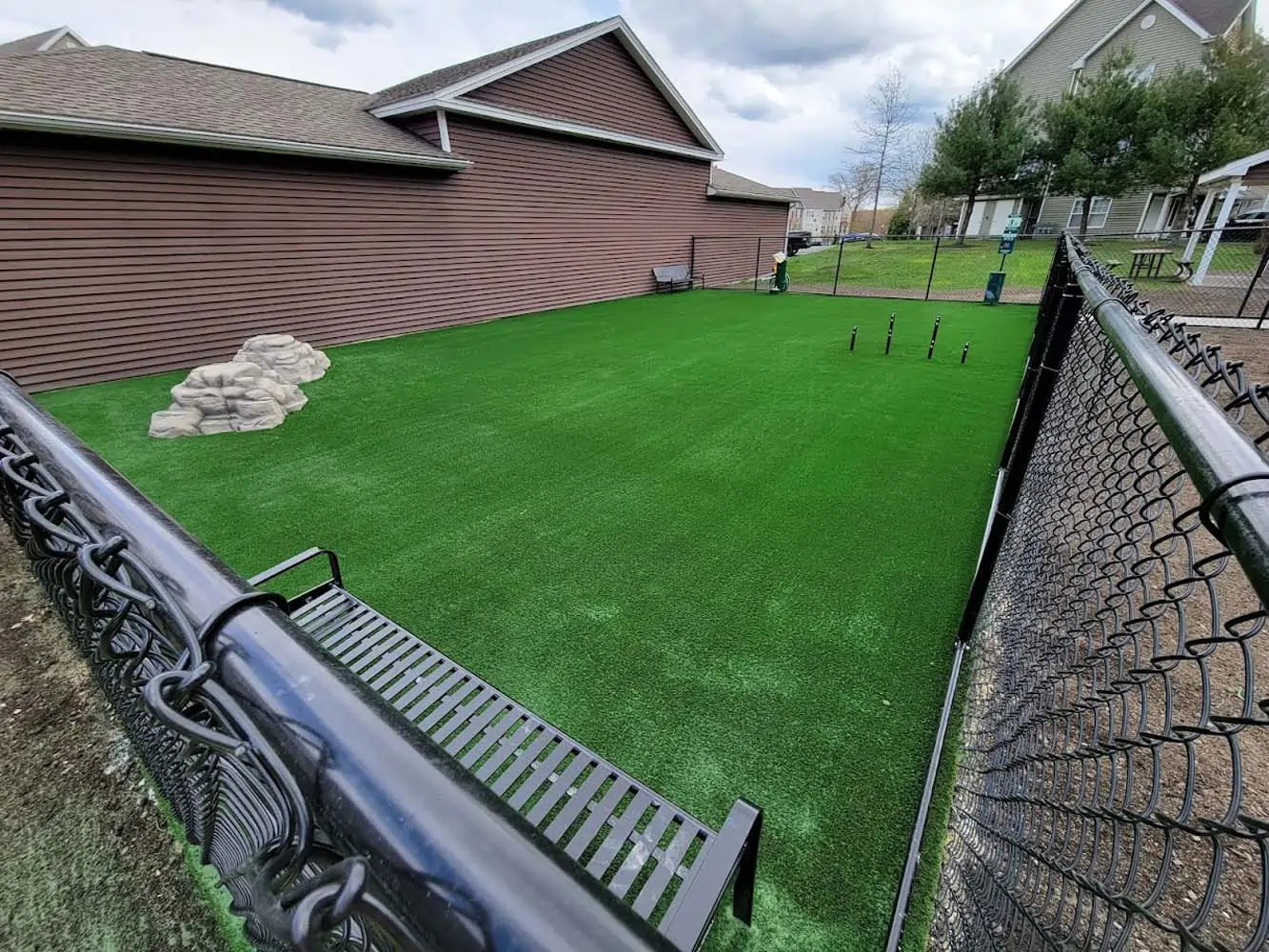
Pet turf installation in Rosenberg addresses a problem that runs through nearly every Fort Bend County residential neighborhood with dogs: natural grass doesn't survive the wear. Backyards in Bonbrook, Walnut Creek, and established Rosenberg sections near the Hwy 59 corridor develop mud channels along fence lines, bare patches under tree canopies, and water retention zones that make cleanup a routine problem rather than an occasional inconvenience. Turf Installation of Rosenberg plans pet turf projects specifically around drainage behavior and cleanup access—not as an afterthought, but as the primary design driver.
Pet turf base systems are different from general residential turf bases in one important way: drainage capacity has to keep up with repeated liquid loading, not just occasional rain events. In Fort Bend County's clay-heavy subsoil, achieving that drainage performance requires a base design that addresses both percolation and lateral movement. Turf Installation of Rosenberg documents the specific drainage behavior of each lot before any base plan is finalized. Properties near the Hwy 59 commercial edge or in denser Rosenberg residential sections often have different drainage profiles than larger lots in Fulshear or Needville, and those differences affect the base specification.
The final pet turf system is designed to handle repeated daily use, seasonal rain, and Texas summer heat without holding odors, developing pooling zones, or breaking down at high-traffic edges. Materials are selected for face weight, drainage rate, and antimicrobial infill compatibility. Perimeter edge treatment is planned to prevent undermining by digging behavior. Turf Installation of Rosenberg handles the full scope from base excavation through grooming and closeout.